 MileMind
Mileage calculator · no sign-up
Annual mileage calculator
Insurance quote asking how many miles a year? Five quick questions, one straight estimate — and what it means for your quote, or your lease allowance.
- No email needed
- About a minute
- Sources shown
- Your figures stay in your browser
What is the average annual mileage in the UK?
The best official figure available is for England, where the average car covered 7,100 miles in 2024. That comes from the Department for Transport's National Travel Survey, table NTS0901. It has been falling steadily — the same figure was around 9,200 miles in 2002 — and it varies a lot depending on what you drive.
| Fuel type | Average miles a year (England, 2024) |
|---|---|
| Petrol | 6,200 |
| Hybrid | 8,000 |
| Diesel | 8,300 |
| Battery electric | 8,900 |
| All cars | 7,100 |
Source: DfT National Travel Survey table NTS0901, published 27 August 2025, as summarised by the RAC Foundation. The National Travel Survey covers England, so there is no directly equivalent UK-wide figure — treat 7,100 as the best available yardstick rather than a UK statistic.
Two things are worth knowing about that average. First, it is per car, not per driver: households run more cars between them than they used to, so each one does fewer miles. Second, DfT's own figures show average distance travelled per person has also gradually declined since the early 2000s — 6,082 miles across all modes in 2024. Both effects push the per-car number down.
Diesel and electric cars sit well above the average largely because they tend to be chosen by higher-mileage drivers, not because of anything about the cars themselves. If you drive an EV and cover 12,000 miles a year, you're normal. If you drive a petrol runaround 4,000 miles a year, you're also normal.
What your insurer actually does with the number
Annual mileage is one of the questions every mainstream UK motor insurer asks, and it is genuinely used to price the policy — more miles means more time exposed to risk. What it is not is a lever you can pull to make the quote cheaper. MoneyHelper, the government-backed money guidance service, puts it carefully: “The lower your annual mileage, the lower your premium might be. But this isn't always the case.” Mileage sits alongside your postcode, age, car, claims history and a dozen other factors, and shaving a couple of thousand miles off your estimate is not a dependable saving.
It is, however, a dependable way to get caught short at claim time.
Getting it wrong is a legal thing, not a paperwork thing
When you answer an insurer's questions you're making a representation, governed by the Consumer Insurance (Disclosure and Representations) Act 2012. The Act asks one thing of you: that you take reasonable care not to misrepresent the facts. If your mileage answer turns out to be wrong, what happens next depends on which side of that line you fall — and on what the insurer would have done with the true figure.
- Careless — an answer given without enough care. There are three possible outcomes. If the insurer would have charged more, it can, in the Act's words, “reduce proportionately the amount to be paid on a claim”. If it would have applied different terms, the policy is treated as if those terms had been in it all along. And if it would not have covered you at all, it can cancel the policy and refuse the claim — though it must then return your premiums.
- Deliberate or reckless — the insurer “may avoid the contract and refuse all claims, and need not return any of the premiums paid, except to the extent (if any) that it would be unfair to the consumer to retain them”. In practice: no cover, and usually no refund.
The same principle appears in the ABI's own code of practice on misrepresentation, which says that where a misrepresentation is careless, “an insurer must apply a proportionate remedy”. That code covers protection products — life, critical illness and income protection — rather than motor, but it reflects the statutory position the whole industry works to.
What that looks like in practice. In a Financial Ombudsman Service decision published in late 2024, a driver had declared 5,000 miles a year. After an accident, the insurer compared the car's last MOT reading with the odometer and found around 6,500 miles covered in six months — roughly 13,000 a year.
The insurer worked out the customer had paid 73% of the premium the correct mileage would have attracted, and paid 73% of the claim. The ombudsman found that mileage adjustment fair. An understatement of about 8,000 miles cost that driver roughly a quarter of their payout.
That case concerned a commercial policy and was decided under the Insurance Act 2015 rather than CIDRA — but as the ombudsman noted in the decision, the expectations and remedies under the two are broadly similar.
They can check, and the data is public
There is a widespread assumption that nobody ever looks. The DVSA has published MOT history — including the odometer reading recorded at each test — as open data since 2018, and named car insurance companies among the users of that data. Anyone, including you, can look up a vehicle's MOT history free on GOV.UK. Ombudsman decisions show insurers pulling exactly those readings when a claim lands, and comparing them against what was declared.
What mileage should I put on my car insurance?
A good-faith estimate, rounded up rather than down. The asymmetry is the whole point: rounding up costs you a little premium, rounding down can cost you a chunk of a claim. That's why this calculator suggests a figure rounded up to the nearest 1,000 rather than handing you a falsely precise number.
And if your driving genuinely changes mid-policy — a new job, a longer commute — it's worth telling your insurer. Many policies include a term asking you to report changes like that, and it's a five-minute call. Reassuringly, honesty is a defence: in another ombudsman case a driver who had reasonably estimated their mileage, then blew past it because of unforeseen work travel and a family bereavement, was found to have taken reasonable care, and the insurer's proportionate reduction was overturned. Careless guessing is the problem. An honest estimate overtaken by life is not.
What the number means if you lease or have a PCP
If your car is on a personal lease (PCH) or a PCP, your annual mileage isn't just a premium input — it's a direct bill at the end of the contract. Allowances are typically sold in tiers: the BVRLA, the trade body for the UK leasing industry, says the most common contracts are for 8,000, 10,000, 12,000 and 15,000 miles a year. Go over the total across the contract and you pay an excess mileage charge per mile.
Published UK excess rates typically run from around 3p to 30p a mile, and premium or performance cars can go well above that — published examples over 50p exist. Close Brothers Motor Finance publishes 10p per mile plus VAT on its PCP agreements. Santander Consumer works an example at 14.90p per mile excluding VAT, and notes the rate may increase once you're more than 5,000 miles over. Several large funders publish nothing at all and simply point you at your agreement — which is where your real number lives.
Three things about excess mileage that catch people out:
- It's usually a total, not an annual test. On most UK leases your mileage is assessed once, at the end, against the allowance for the whole contract, so a heavy first year followed by a quiet second year evens out. Some agreements — and some large fleet schemes — work differently, so check yours.
- Handing it back early changes that. The BVRLA says that if you end a PCP or hire purchase agreement early, excess mileage is worked out pro rata for the time you had the vehicle. Lease agreements commonly work the same way — so an early return can turn a comfortable position into a charge overnight.
- VAT is a 20% swing. Some agreements quote the pence-per-mile rate including VAT, others plus VAT. The calculator above has a toggle for exactly this, because getting it wrong makes a £600 estimate a £720 bill.
And it runs the other way too: there are normally no refunds for miles you didn't use. Buying a 15,000-mile allowance you never touch is money handed over for nothing. The right allowance is the honest one — which is the same answer as the insurance question, for the same reason.
See how MileMind tracks lease mileage pace →
How this calculator works out the number
No black box. Four lines of arithmetic, all visible:
- Commute — days a week × round trip × 46 weeks. Not 52: almost all UK workers are entitled to 5.6 weeks' paid holiday a year, which leaves 46.4 working weeks, and we round to 46 to keep the commute figure conservative.
- Local driving — weekly miles × 52.
- Longer trips — monthly miles × 12.
- Holidays and one-offs — number of trips × round trip.
Those four add up to your estimated annual mileage, which we show rounded to the nearest 100 — and then separately suggest a figure rounded up to the nearest 1,000, because rounding up is the direction that protects you on an insurance form.
If you fill in the optional sanity check, we divide the miles you've added by the months you've had the car and annualise it. That real-world figure beats any estimate on this page, and if the two disagree badly, trust the odometer.
The fuel estimate converts your miles to gallons using the MPG you set, converts gallons to litres at 4.546, and multiplies by the pence-per-litre you set. It covers fuel only — not insurance, tax, servicing, tyres or depreciation.
The optional commute lookup on step one is the only part of this page that talks to anything outside your browser. It uses Apple Maps (MapKit JS) to turn the two addresses you type into a real driving route, then doubles the one-way distance for the round trip and fills it in for you. It's the same mapping data the MileMind app itself uses. You can always overwrite the figure it produces — it's a starting point, not a verdict, and a route you actually drive may differ from the one Apple picks.
Work it out on paper
No calculator needed if you'd rather not. Add up a typical week's driving — commute plus everything else — multiply by 52, then add your long trips for the year on top. Round the answer up to the nearest 1,000.
| Miles in a typical week | Roughly, miles a year |
|---|---|
| 50 | 2,600 |
| 100 | 5,200 |
| 150 | 7,800 |
| 200 | 10,400 |
| 250 | 13,000 |
| 300 | 15,600 |
| 400 | 20,800 |
| 500 | 26,000 |
Weekly miles × 52, before long trips and holidays are added. Use it as a floor, not a final answer.
Where these figures come from
- Average annual car mileage in England, 2024 (7,100 miles), the fuel-type split and the 2002 comparison — Department for Transport, National Travel Survey, table NTS0901, published 27 August 2025, as summarised by the RAC Foundation.
- Average distance travelled per person, 2024 — DfT, National Travel Survey 2024: introduction and main findings.
- Careless and deliberate misrepresentation remedies — Consumer Insurance (Disclosure and Representations) Act 2012, Schedule 1.
- “An insurer must apply a proportionate remedy” — ABI, Code of Practice: Managing Claims for Individual and Group Life, Critical Illness and Income Protection Insurance Products, September 2019. That is a protection code rather than a motor one — cited for the principle, not as motor-specific authority.
- The 73% proportionate settlement example — Financial Ombudsman Service decision DRN-5199436 (a commercial policy, decided under the Insurance Act 2015).
- The honest-estimate case that was upheld — Financial Ombudsman Service decision DRN-5457156.
- MOT odometer readings as open data, and insurers named among the users — DVSA, January 2018. Check any vehicle free at GOV.UK MOT history.
- “Lower mileage might be cheaper, but not always” — MoneyHelper, car insurance guidance.
- Common lease allowance tiers — BVRLA leasing top tips. Pro-rating of excess mileage on early termination — BVRLA leasing FAQs.
- Published excess mileage rates — Close Brothers Motor Finance (PCP, conditional sale and hire purchase) and Santander Consumer Finance. The 8p–15p “mainstream” band mentioned in the calculator is our own read across published broker and lender rates, not a single published figure.
- Average unleaded pump price, week commencing 20 July 2026 — Department for Energy Security and Net Zero, weekly road fuel prices.
- Statutory holiday entitlement of 5.6 weeks, behind the 46-working-week assumption — GOV.UK holiday entitlement.
This page is general information about how mileage figures are used, not insurance or financial advice. Every figure it produces is an estimate. Your own policy documents and lease agreement are what govern what you pay.
An estimate is a guess. MileMind counts.
This page gives you a good number once. MileMind keeps it true — every fill-up, every renewal, every mile against your lease allowance, in one honest running total. Private, no ads.
Download on App Store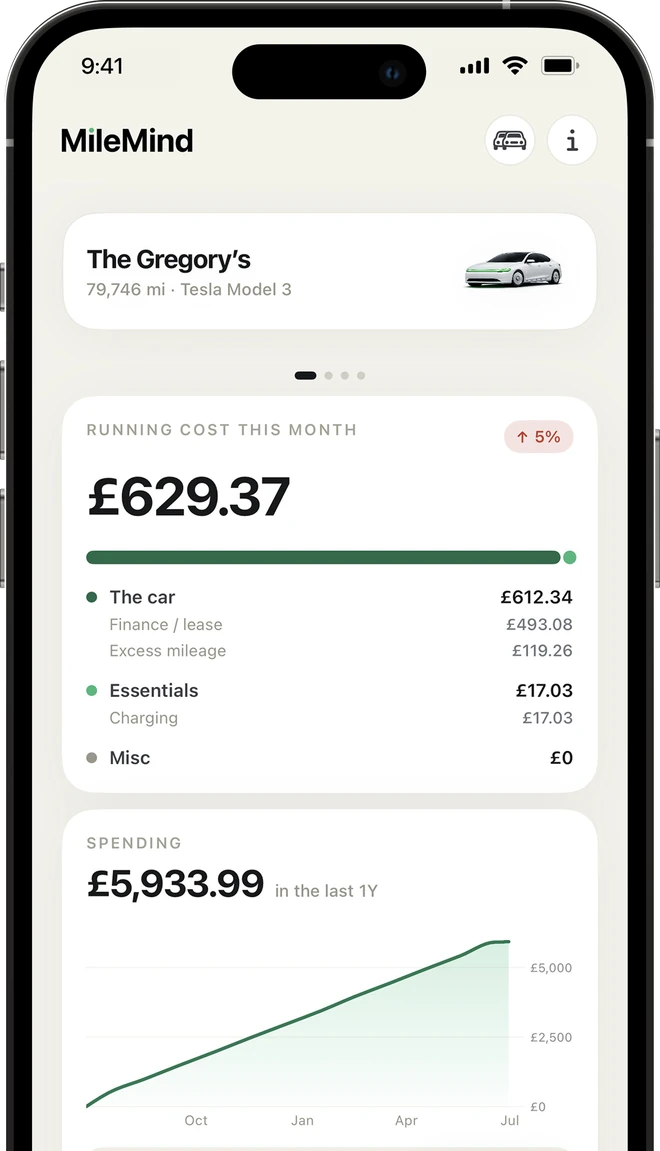
Common questions
What is the average annual mileage in the UK?+
What mileage should I put on my car insurance?+
What happens if I underestimate my annual mileage on my car insurance?+
Can insurers check my real mileage?+
Should I round my annual mileage up or down?+
Does lower mileage always mean cheaper car insurance?+
How much is excess mileage on a lease or PCP?+
Is lease mileage checked every year?+
Is this calculator free, and what happens to my answers?+
Related reading